Quick answer
The cost of a Shopify store has no single figure because it is the sum of eight drivers: the Shopify subscription (check Shopify's current pricing page), theme, apps, custom development, content and photography, integrations, data migration and ongoing maintenance. Custom functionality, integrations and the amount of content you must create move the total far more than the number of pages, which is why quotes for similar-looking stores differ widely.
Key takeaways
- A Shopify store's cost is driven by scope, not page count: custom features, integrations and content creation are the big levers.
- Recurring costs (plan, apps, payment fees, maintenance) often outweigh the one-off build over a few years, so compare total cost of ownership.
- Using a premium theme with light customisation is the most reliable way to control build cost; custom themes pay off only when they solve a specific commercial problem.
- Quotes vary because agencies assume different scope, content responsibility and QA depth; a written brief makes quotes comparable.
- Phasing the build, launching lean and adding features after you have sales data keeps spend tied to evidence.
"How much does a Shopify store cost?" is the first question most founders ask and the one with the least useful answers online. Price lists without context tell you nothing about your project, and two stores that look identical on a phone can be very different builds underneath.
The better question is: what will drive the cost of my store? Once you know the drivers, you can decide which ones to spend on, which to postpone, and how to compare agency quotes on equal terms. This article walks through all eight, explains why quotes vary, and shows how to brief a project so the estimate you get back is accurate.
Why Is There No Single Answer to What a Shopify Store Costs?
There is no single answer because a Shopify store is a combination of a subscription, a theme, apps, custom code, content and integrations, and each varies independently. A store with ten products on a lightly customised theme and a store with a product configurator linked to an ERP are both "Shopify stores".
Two things follow from this. First, any figure you see without a defined scope is marketing, not an estimate. Second, you control more of the cost than you might think, because several drivers are choices rather than requirements.
What Are the Main Cost Drivers of a Shopify Store?
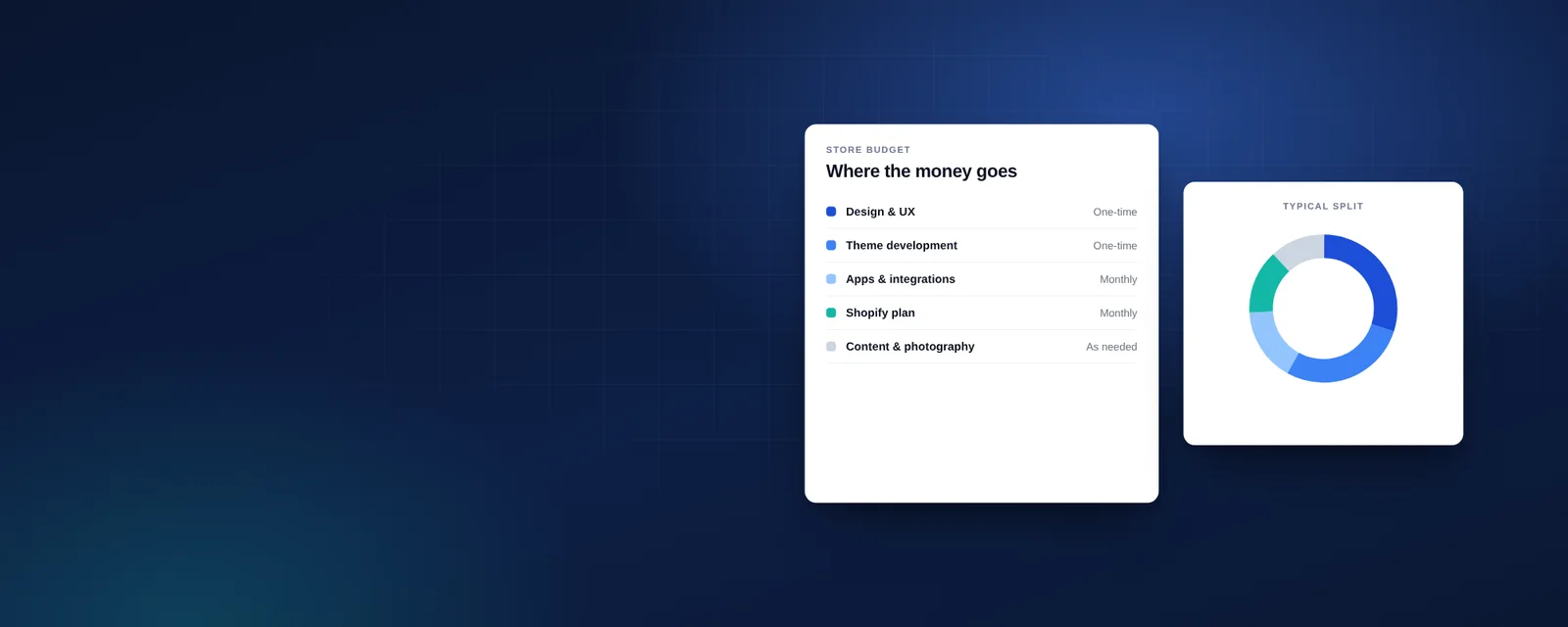
The eight cost drivers are the Shopify subscription, theme, apps, custom development, content and photography, integrations, migration, and ongoing maintenance. The table shows what pushes each one up or down.
| Cost driver | What it covers | Pushes cost up | Keeps cost down |
|---|---|---|---|
| Shopify subscription | Platform plan and payment processing | Higher plan for staff or reporting; Shopify Plus; third-party gateways that attract extra transaction fees | Smallest plan that fits; Shopify Payments where available |
| Theme | Free, premium or custom-built theme | Custom design system; heavy edits to a premium theme's code | Premium Online Store 2.0 theme configured in the editor |
| Apps | Reviews, email, subscriptions, upsells, filters and more | Many overlapping apps; usage-based pricing that scales with orders | Short essential list; regular audits; built-in Shopify features first |
| Custom development | Custom sections, logic, apps and checkout extensions | Configurators, custom bundles, subscription builders, B2B pricing rules | Using proven apps for standard features |
| Content and photography | Copy, product data, images, video, translations | New shoots, many SKUs, multilingual stores, Arabic and English layouts | Reusing existing assets; supplying clean product data |
| Integrations | ERP, accounting, 3PL, CRM, marketplaces, e-invoicing | Two-way sync, custom middleware, legacy systems without APIs | Off-the-shelf connectors; one-way data flows |
| Migration | Moving products, customers, orders, URLs and content | Years of history, custom fields, subscriptions, SEO-critical URLs | Clean CSV exports; migrating only what you need |
| Ongoing | Maintenance, updates, new campaigns, support | Heavily customised theme; many apps; frequent landing pages | Theme close to vendor version; documented code; retainer sized to need |
How Does the Shopify Subscription Affect Total Cost?
The subscription is predictable but recurring, so it matters more over three years than at launch. For current plan fees, see Shopify's pricing page; they change and vary by country.
The less obvious subscription cost is payment fees. Shopify charges a third-party transaction fee when you take payment through an external gateway rather than Shopify Payments, and its help centre states this applies even when Shopify Payments is also active, with PayPal and manual payments excluded in that case. If you are based where Shopify Payments is not offered, such as Saudi Arabia, this is a real line in your model, not a rounding error.
Plan upgrades are usually triggered by staff accounts, reporting needs, calculated shipping rates or checkout customisation, which on Shopify is fully available only on Shopify Plus.
How Much Does the Theme Choice Change the Build Cost?
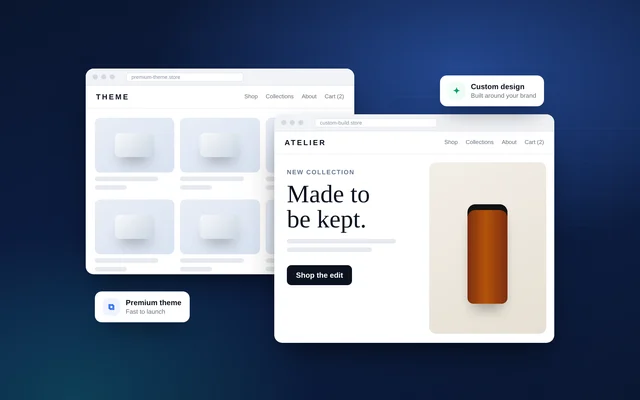
Theme choice is the single biggest lever on build cost. A premium Online Store 2.0 theme configured through the theme editor is the lowest-risk route; a fully custom theme is a design and development project in its own right.
The middle path, a premium theme with custom sections added, is where most growing brands land. The cost rises with every edit to the theme's core files, because Shopify does not apply automatic bug-fix updates to customised themes, and code edits that conflict with a vendor update must be copied across by hand. Keeping custom work in separate sections and snippets keeps future updates cheap. Our comparison of custom vs premium Shopify themes explains where the line usually falls.
Why Do Apps Become One of the Largest Recurring Costs?
Apps are cheap individually and expensive in aggregate, because most are monthly subscriptions and some scale with your order volume. They also add scripts that can slow the storefront.
A typical drift: a review app, an email platform, a subscriptions app, a bundles app, an upsell widget, a pop-up tool, a size-guide app and a currency converter that Shopify Markets already replaces. Audit the list quarterly, remove anything unused, and favour apps built on theme app extensions, which Shopify notes are removed cleanly when uninstalled. Sometimes a one-off custom section replaces a recurring app subscription and pays for itself.
When Does Custom Development Drive the Cost Up?
Custom development drives cost when the store must do something a theme or app cannot do well, such as configure a product, build a custom subscription, apply B2B pricing rules or extend checkout. Each feature needs design, build, edge-case handling and testing.
Two examples from our own work show the kind of scope involved. For Rijpex we built a pergola configurator with dynamic sizing, colours, accessories and upsells; for Joyful Cacao we built a three-column product page with a custom subscription builder. Neither is a page-count problem; both are logic, state and testing problems, and they are priced accordingly.
Ask for custom features to be estimated separately from the base build, so you can see what each one costs and decide whether it belongs in phase one.
How Do Content, Integrations and Migration Affect the Budget?
Content, integrations and migration are the drivers most often left out of early quotes, and they are where budgets overrun. Clarify who owns each before you sign.
- Content and photography: writing product descriptions, producing images and video, and entering data for hundreds of variants is real work. Bilingual stores need a second full set of copy plus layout testing in both directions; see building a bilingual Arabic–English Shopify store.
- Integrations: connecting Shopify to an ERP, accounting system, warehouse or 3PL ranges from installing a connector to building custom middleware. Two-way stock and order sync across locations is a software project. UAE B2B sellers should also check whether their Shopify store needs UAE e-invoicing.
- Migration: moving products, customers and orders, mapping old URLs to new ones and setting up redirects (Shopify supports bulk redirect imports by CSV) protects your search traffic. Our migration checklist lists what to move and test.
What Ongoing Costs Come After Launch?
After launch you pay for the platform, apps, payment fees and the developer time needed to keep the store current. Shopify itself changes, and those changes create work.
A recent example: Shopify set 26 August 2026 as the deadline for non-Plus stores to upgrade their Thank you and Order status pages, which meant replacing legacy scripts and tracking with compatible apps and pixels. Stores with heavily customised checkout-adjacent code had more to redo. Similar platform updates arrive every year, so budget for maintenance as a line, not a surprise.
Why Do Shopify Agency Quotes Vary So Much?
Quotes vary because agencies are pricing different assumptions, not because one is honest and the other is not. Scope, content responsibility, revision rounds and QA depth are the usual differences.
- Scope interpretation: "product page" can mean configuring a theme template or building a custom layout with bundles and metafields.
- Content ownership: some quotes assume you supply finished copy and images; others include content entry or writing.
- Discovery: a paid discovery phase reduces risk on complex projects but appears as an extra line.
- QA and devices: testing on real devices, browsers, payment methods and markets takes time.
- Team model: senior specialists, generalists and offshore or white-label teams have different rate structures.
- Pricing model: fixed price includes a risk margin; time and materials passes risk to you.
Ask every agency to list assumptions and exclusions in writing. Our guide on how to choose a Shopify agency includes the questions that make quotes comparable.
How Do You Get an Accurate Shopify Quote?
Send a short written brief with your catalogue size, must-have features, integrations, content status, target markets and launch date. A clear brief removes guesswork, and guesswork is what agencies price in as contingency.
Include examples of stores you like and say why, separate must-haves from nice-to-haves, and state whether you are migrating from another platform. If you are still deciding between platforms, read Shopify vs WooCommerce first, because the cost drivers shift between them. For a full launch sequence, see how to launch a Shopify store that sells.
How TexaNEX Helps
TexaNEX is a Shopify, web and software development agency that also builds Peppol e-invoicing platforms for the GCC, working with clients in the US, UK and the Gulf for over 11 years. We scope Shopify projects driver by driver, separate custom features from the base build, and write down assumptions so you can see exactly what is included. If you have a brief, or just a list of must-haves, our Shopify development team can turn it into a scoped plan, or you can get in touch directly.
Frequently Asked Questions
Is a Shopify store cheaper to run than a self-hosted store?
Shopify bundles hosting, security patching, SSL and checkout into its subscription, so you avoid separate hosting and server maintenance. A self-hosted platform such as WooCommerce has no platform fee but shifts hosting, updates and security to you or your developer. Which is cheaper depends on how much custom functionality you need and who maintains it, so compare total cost of ownership over several years.
What ongoing costs should I expect after launch?
Expect the Shopify subscription, payment processing fees, recurring app subscriptions, any premium theme renewals for updates, and developer time for changes, new campaigns and fixes after app or theme updates. Content production for ads and social is often the largest ongoing line for growing brands. Budget for a periodic app audit, because unused subscriptions quietly accumulate.
Does Shopify charge transaction fees?
Payment processing fees apply to every card payment whichever provider you use. In addition, Shopify charges a third-party transaction fee when you use an external gateway instead of Shopify Payments, and this applies even when Shopify Payments is also active, with PayPal and manual payments excluded in that case. Rates depend on your plan, so check Shopify's current pricing page.
Why do two agencies quote very differently for the same store?
They are usually quoting different projects. One may assume you supply all copy and images, a single round of revisions and basic testing; another may include content entry, custom sections, tracking setup and device testing. Team model, location and fixed-price versus time-and-materials billing also change the number. Ask each agency to list its assumptions and exclusions.
Can I start on a lower budget and upgrade later?
Yes, and for most new brands it is the sensible route. Launch on a well-chosen premium theme with essential apps, then invest in custom sections, subscriptions or integrations once sales data shows where the bottlenecks are. Shopify plans can be upgraded without rebuilding the store, and Online Store 2.0 themes let you add sections over time.
How much does it cost to migrate to Shopify?
Migration cost depends on the volume and messiness of your data, whether you need historical orders and customer accounts, how many URLs need redirects, and whether the design is being rebuilt at the same time. Clean product data with simple variants is quick to move; years of custom fields, subscriptions and SEO-sensitive URLs take careful mapping and testing.
Sources
- Shopify pricing — Shopify
- Third-party payment providers — Shopify Help Center
- Updating themes — Shopify Help Center
- Theme app extensions — Shopify.dev
- Upgrading Thank you and Order status pages — Shopify Help Center
- URL redirects — Shopify Help Center
Facts checked against the sources above as of 6 Oct 2026. Rules and platform features change, so confirm time-sensitive details before acting.

TexaNEX Editorial Team
Written by the strategists, developers and e-invoicing engineers at TexaNEX, a Shopify, web and software development agency that also builds Peppol e-invoicing platforms for the GCC, with 1,200+ projects delivered over 11+ years. About us